

One of my clients, Watertrust Australia, has been crafting a fascinating piece of work throughout 2024. They’ve done a deep dive into the question of how various stakeholders in the deeply divided Murray-Darling Basin water sector define the seemingly straightforward words “equity”, “fairness” and “justice”.
Watertrust has explored how a person’s world view frames their perception of what is fair. With stakeholders ranging from irrigators to environmentalists, First Nations communities to hydro scheme management, riverside communities to industrial and farming, among others, one person’s idea of “fair” distribution of water can feel deeply inequitable to somebody else.
This equity project is something only the collected skillsets of Watertrust could probably even attempt. Completely funded by philanthropy, over an agreed long arc for maximum effect, Watertrust’s policy and water experts have been free to approach the project from an independent, non-partisan position, without a dog in the fight as it were, examining papers, policy, and legislation across Australia, as well as surveys of all viewpoints across the sector, workshops and discussions with stakeholders. With unrelenting pressure on policy-creators to “fairly” divide our precious freshwater and groundwater resources among so many vested interests, Watertrust will deliver a policy paper to not only drive a debate about equity definitions in policy, but to discover practical and tangible ways government policy makers can consider equity, justice and fairness in their work.
Part of that consideration must be about future water and how it will be protected and used for generations of Australians not yet born, and it’s in that future gazing that you realise the project has ramifications even beyond the immediate and serious needs of the water sector to better understand one another.
Threats to water come from all angles and on Thursday, December 5, I found out about a new one, when Professor Kate Crawford delivered the Helen Macpherson Smith Trust lecture at Melbourne’s state library. A global expert on AI, she discussed the planetary impacts of this new, rampant technology, especially with regards to its insatiable demand for our private data, and the real-world environmental impact of the energy and resources required to power generative AI. Did you know a standard ChatGPT interaction consumes roughly half a litre of water? Or that huge Google data centres processing generative AI in The Dalles, Oregon, an area currently in drought, used one billion litres of water in 2021 (a figure made available only after a protracted legal battle).
Professor Crawford used this example to speak of how the rise of AI was yet another, quite dramatic tilt in the wrong direction when it came to equality and fairness between the world’s most wealthy elite and the rest of us.
She estimated only five companies (three in the United States and two in China) boasted the international data grunt and cloud capacity to truly generate a Large Language Model at global scale. Tied into social media platforms that we used to think were cute ways of sharing photos and messages with family and friends, but now turn out to have been personal retroactive data-mines for facial recognition and every other aspect of our lives, these companies, run almost unregulated by a few, now drive the online world, including information searches and what may or may not be true. In two decades of Facebook posting, along with other social media platforms, we have inadvertently given the top 0.1 of the renowned “1 per cent” our most private selves. Who benefits from that? Us or them?
“There is a deep inequity over who is benefitting from AI,” Professor Crawford told the audience. “In the last five years, the divide has increased so rapidly between the billionaires becoming so much richer, and the rest of the world, many of whom are struggling to pay for food.
“How we are going to think about equity is one of the biggest questions for the next decade.”
This comment brought me back to the Murray-Darling Basin. In Australia, where we face intense climactic pressure, and increasingly threatened freshwater supplies, we need full transparency over how much water the cooling systems for generative AI data centres are taking from everybody else.
American political scientist Howard Lasswell defined politics as being, ”Who gets what, when, how?” Brexit, the Far Right ascendancy across America, Germany, Italy and other countries, and now the looming prospect of Donald Trump’s return as President, can all be seen as stemming from a rage among lower and middle classes that they’re worse off than their parents, and now consider themselves, unhappily, among the “have nots”. I’ve never personally understood how they could see people like Nigel Farage, Trump or Elon Musk as being their heroes, or even allies, but the sense of inequality in the world is real and, as Professor Crawford eloquently explained, is getting worse.
Away from the headlines, there is deep work happening to address the situation. Organisations such as the UK’s School of International Futures are dedicated to investigating how we can build equity for future generations and share wealth over the decades to come.
One of the reasons I love working with philanthropy and charities, as a cornerstone of my storytelling practice, is that the giving sector is where you find people who are prepared to do this more difficult, important work; to deep dive into complex issues, looking for genuine solutions and ways to make people’s lives better.
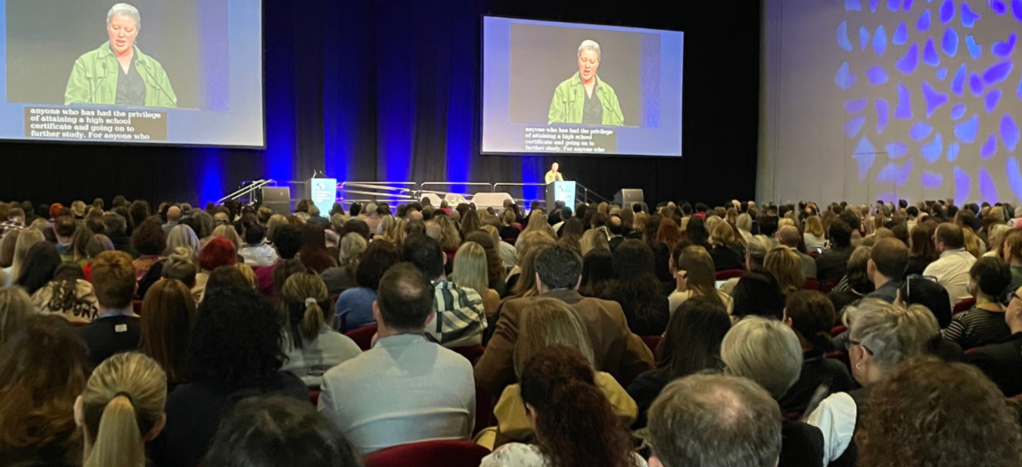
Notably, at this year’s Philanthropy Australia conference in Adelaide, this included looking backwards, asking hard questions about the source of philanthropic money, or truth-telling about the people whose statues litter our cities or whose names now adorn foundations. For me, the most powerful moment of the conference was Stacey Thomas, CEO of the Wyatt Trust, gazing fearlessly at how her trust’s founder, English settler Dr William Wyatt, had impacted the Kaurna First Nations communities of Adelaide, as their “Protector”, including instructions on their management that effectively described slavery.
Stacey’s speech got to the heart of intergenerational justice and fairness. The Wyatt Trust does great work, battling South Australian poverty, including among First Nations communities, but for true reconciliation and for future South Australian Kaurna generations to feel respected and have a deep sense of equity, the Trust’s current truth-telling exercise is vital.
And hard.
Like the Murray-Darling debate on how water gets distributed fairly. The search for justice for all continues.

 NOISY BOY MEDIA

1 Comment